
Why aerate the lawn
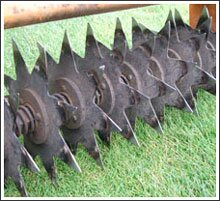
All soil types are vulnerable to compaction, although heavy clay soils are more prone to this than light sandy soils due to the small soil particles of clay. Lawn aeration is the process of relieving compaction and increasing air space to help promote healthy growing conditions for grass. Also, with the best lawn aerators, you can do this essential process faster and qualifier.
Compaction is a result of compression placed on the soil particles, which causes a breakdown in soil structure resulting in a lack of air. This in turn hurts the health of the lawn often resulting in weak grass coverage.
Compaction causes the pore spaces in the soil to become small, thus reducing the amount of air held in the root zone. This inhibits drainage, hurts rooting, and encourages shallow-rooted grasses which in turn will reduce drought resistance. Over a period lawns can become compact, especially if they are heavily used and receive little or no aeration.
Lack of air also hurts microorganisms in the soil, which need air to survive. Micro organisms are required to break down the thatch layer and return nutrients to the plant. Overall a lack of air has a detrimental effect on the health of your lawn.
Best Lawn Aerators in the UK: Comparison Table
| Image | Product | |
|---|---|---|
Best Choice, Eco-friendly  | Einhell GC-SA Electric 2-in-1
| Check Price |
Best Petrol Aerator  | Hyundai 212cc Petrol 2-in-1
| Check Price |
Also Great  | Walensee Lawn Coring Aerator
| Check Price |
Low price  | Greenkey Rolling Lawn Aerator
| Check Price |
Low price  | GRÜNTEK Lawn Aerator Shoes
| Check Price |
The benefits of aerating the lawn
The purpose of aerating is quite simple, to let air and water into the soil and to relieve compaction.
A healthy well-aerated lawn has several benefits, these benefits include:
- An increase in desirable bent and fescue grasses over annual meadow grass. Bents and fescues are easier to maintain, are more drought-resistant, require less fertiliser, and are more disease resistant (especially against fusarium patch). They produce a better quality lawn (Bents and fescues are the favoured grasses on golf and bowling greens).
- An improvement in rooting, producing a healthy drought-resistant lawn.
- Encourages micro organisms which are beneficial to the soil as they aid thatch breakdown. They are also beneficial in helping with disease resistance as they inhibit the pathogens that cause the disease.
- Aids irrigation by helping the water go down to the roots and reduces surface runoff.
- If lawn aeration is carried out before top dressing it helps improve the soil structure as the top dressing fills the channels created by the aeration.
- Can be also beneficial to drainage by creating channels for the water to penetrate and drain away.

Best time to aerate a lawn
Ideally, you should aerate your lawn twice a year. But you also need to take into account the climatic conditions, the types of plants planted and the amount of stress on the lawn. Based on this, determine the number of necessary procedures:
- If the lawn is sports type, subject to trampling and high stress, aeration is performed 2-3 times a year.
- When the season is unfavourable weather conditions, for example, it is too dry or there are frequent heavy rains, additional aeration procedures may be necessary.
- Unscheduled aeration will be necessary if areas of yellowing grass or moss are found on the lawn.
- Also, the number of aeration varies depending on the soil: if it is sandy – one procedure is enough for the season, on the clay will need 2-3 aeration. Clay soil is faster and stronger pressed compared to other types of soil, so it should be aerated more often.
When turfgrass and fescue grasses are planted on the lawn, the piercing is done in autumn, as these grasses are cooler late-season plants. In the case of a lawn planted with heat-loving Bermuda grass, aerating is done in late spring or early June.
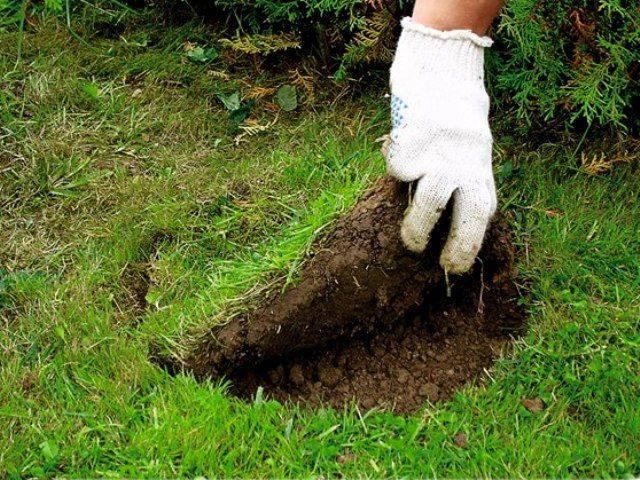
There is a way to tell if it is time to aerate. You need to carefully with your own hands with a small garden spatula to cut a small piece of lawn and carefully examine the root system. If the roots are small (up to 5 cm in length), then they do not get enough oxygen and aeration should be carried out as soon as possible. And one more important point, if you want to do weed control on the lawn, do not aerate until you have removed all the weeds.
The ideal time for aeration is during the spring and autumn as part of the respective lawn care programs. Aerating during these periods means the aeration can be incorporated with other operations which complement each other such as overseeding and top dressing.
Aerating according to the rules
If you planned to do aeration, then a couple of days before the procedure, you need to water the lawn, the soil will become softer and easier to pierce. You can carry out soil aeration activities the day after the rain, only if it was not torrential and the soil is not too wet. Ideally, the soil should be slightly moist before aerating. Never undertake such a procedure if it’s hot outside. There is a chance of ruining the lawn permanently. If the soil is too compacted, aerate again. But the second time the aerator must be moved in a direction perpendicular to the previous procedure.
The strips made by the aerator should overlap each other by 3-4 cm. After piercing the lawn, it is a good idea to feed it. And in those places where there are gaps, it is necessary to sow grass. After two days of aeration, the soil should be smoothed out with a rake.
Tools for aeration
Aerators come in two types:
- Working by human power, they are used when the lawn area is not too large.
- Self-propelled, which are equipped with a motor, they are used to aerate lawns of impressive size.
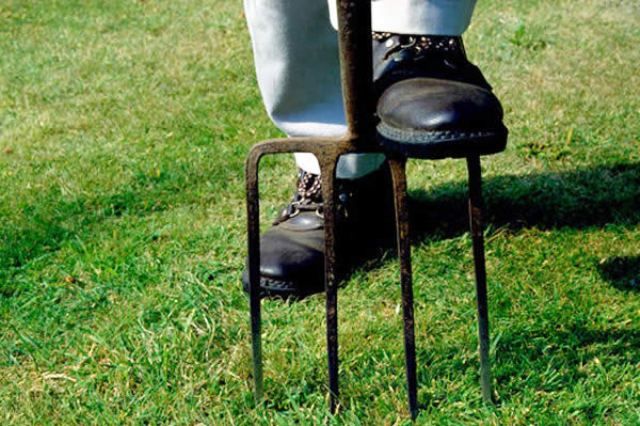
Aerators of the first type can be quite possible to make in the cottage with your own hands. Of course, if there is no time for this, you can use a garden fork or a fan rake. Forks make punctures about 10 cm deep. In principle, this is enough, but this method is applicable only for small plots. Because if the lawn is large, a pitchfork will take too much time.
Rake aerators cope well with the task of aerating the lawn. Instead of pins, they have thin steel rods that are shaped like a sickle. Through the use of such rakes, the soil is slightly notched horizontally and the dead grass residue is combed out, which also prevents the penetration of moisture and oxygen. Aerator rakes are sold in specialized gardening departments of hypermarkets. But special craftsmen and dreamers can mount such a tool with their own hands from the materials available on the garden plot. For piercing the lawn cover, there are also devices, shaped like a rake, which have rotating teeth.

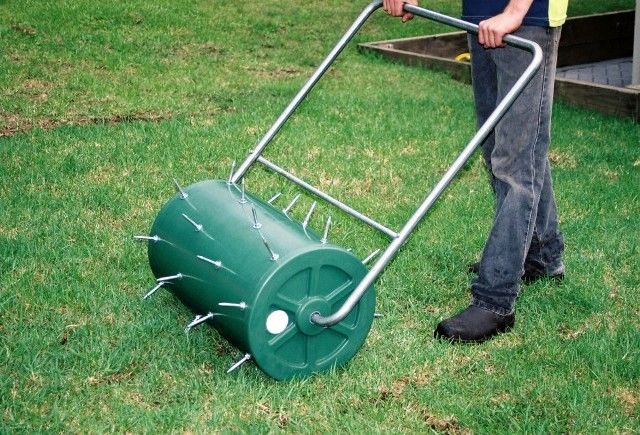
There is also a device on two wheels, equipped with solid or hollow long spikes. With such devices, it is possible not only to aerate the soil but also to loosen it. Among country house owners, sandals or boots for aeration, which have vertical spikes on the sole, are particularly popular. They can be worn over other shoes and walk across the lawn, piercing its surface. This option is not suitable for large areas, even the most trained feet and pumped-up muscles will get tired from a long walk with heavy devices.

Tools for aerating the soil can have different teeth:
- Continuous. When piercing the turf layer, a hole is formed, and the soil is not displaced.
- Hollow. Soil is extracted and spread over the lawn, the diameter of the hole is small, only 1-2 cm.
Which aerator to choose for the best result?
Well, for large lawns, units running on electricity or gasoline are well suited. For them to last a long time, you need to fill only quality fuel. Of all the options of aerators considered, you have to choose, taking into account many factors:
- the size of the lawn area;
- financial ability;
- how far away the lawn is from the house;
- the time commitment.
That is, whether the owner has so much time to, for example, all day pierce his lawn with a pitchfork. Or is it better to spend once on a self-propelled machine? Here, too, do not cut corners. All think carefully, if anything, for the first time you can make your own hands sandals-aerators. And then save up money and buy a good self-propelled device.
The different types of lawn aeration

There are a few different types of lawn aeration, with many different implements and machines on the market. We will explain the different types of aeration and the different benefits that each has. They are as follows:
- Spiking or Solid Tining: Probably the most common type of aeration on a lawn because most people have a garden fork. However, there are machines available for this task. Spiking is particularly useful during the summer months before irrigation to help the water penetrate the soil profile. Spiking is preferred to slitting in the summer due to the fact after slitting, the slits are prone to opening up if it is dry.
- Slitting: Slitting is not as common as spiking for lawn aeration however there are benefits of slitting over spiking. They can generally penetrate deeper than spikes and also have the added benefit of root development as slitting prunes the roots. Deep slitting would be used in the autumn and winter months.
- Hollow Tining or Core Aeration: This process involves the removal of cores from the lawn. The main benefit of this method would be to remove thatch. This is also very beneficial before top dressing as it leaves larger holes (which stay open than other types of aeration. Therefore it is easier to work in top dressing through the holes and into the root zone.
Core aeration, hollow tining the lawn

Core aeration (hollow tining) is a lawn aeration technique that physically removes small cores or plugs from the lawn, to create a healthier environment for grass growth.
Core aeration is also called hollow tine aeration. Small hollow metal tubes are punched into the lawn surface with the cores being ejected from the soil onto the surface of the lawn.
Types of core aeration machinery
Core aeration or hollow tining can be undertaken with either a powered lawn/core aerator, a tow-behind aerator or a simple hollow tine hand fork.
- Powered core aerator – These machines are generally powered by a petrol engine and are designed to cover large lawns in a short space of time. The tines can either be mounted to a cylindrical frame, drum or spool which penetrates the turf as the drum rotates over the lawn. Alternatively, the tines may be mounted on legs that are attached to a cam-type system. On this type of core aerator, the tines are punched vertically into the lawn to remove the core or plugs. Punch action core aerators generally penetrate deeper into the soil than drum-type aerators. The main disadvantage of these machines is the cost of purchase. In most cases, it is better to hire rather than purchase a powered core aerator, or use an alternative method to aerate the lawn.
- Tow-behind core aerator – As the name suggests these core aerators or towed behind a garden tractor or similar. The tines are fixed to a drum or spool, which penetrates the lawn, removing the cores as it travels over the lawn. Some models have a weight tray to add extra weight to the machine to increase tine penetration. Tow-behind aerators are great for large areas, and the cost of purchase is quite reasonable making them an ideal alternative to powered core aerators. The main drawbacks are the tine’s lack of penetration depth, and they are unsuitable for small, tight lawns.
- Hand core aerator fork – These simple tools are very popular for core aeration and are designed similar to a hand fork, but hollow tines replace the standard fork tines. They are simply pushed into the soil to remove the cores. These implements are ideal for smaller lawns where larger machinery is difficult to manoeuvre. They are not suitable for large lawns as they are very time-consuming and they can be very laborious. If used when the soil conditions are moist, full tine depth can be reached, ensuring a very thorough job.
Why core aeration
There are numerous benefits that core aeration has over standard lawn aeration such as spiking and slitting. As we have already stated core aeration (hollow tining) removes cores, while other types of aeration just punch holes in the lawn. The major benefits of removing cores are:
- Reduce the influence of thatch on the lawn – An excessive layer of thatch on the lawn is one of the primary reasons for poor lawn health and countless other common lawn care problems. Hollow tining or core aeration physically removes the thatch from the lawn, resulting in a healthier lawn with fewer problems.
- Incorporate a soil exchange program – Many lawns suffer from various problems such as lack of drought resistance or poor drainage. It is possible that these problems can be alleviated with core aeration. As core aeration leaves wide, deep holes in the lawn, a suitable top dressing can be applied and worked down the core holes and into the soil. If done regularly the soil composition can be gradually changed to help rectify the underlying problems with the soil.
- Relieve soil compaction – Although all types of aeration help relieve soil compaction, core aeration is more beneficial than other types of lawn aeration. This is because where the cores plugs have been removed the surrounding soil is allowed to expand, thus being more effective at reducing soil compaction.
Conclusion
Although core aeration can be carried out at almost any time during the year (ground conditions permitting) the growing season is the best time, late summer or early autumn is preferable. This is because it complements the autumn lawn care program, which also includes overseeding and top dressing. Both of these two tasks will benefit greatly from core aeration being carried out before them.
However, if you have a serious problem with excessive thatch build-up, or need to change the composition of the soil by applying the top dressing, then core aeration can also be undertaken during the spring or even at suitable times during the summer, again weather and ground conditions permitting.
This task is best carried out when the lawn surface is dry. Before aerating, mow the lawn, as this will help with core collection.
